When Henry had a seizure shortly after his third birthday, Georgia’s world changed overnight. What followed was a diagnosis of a rare form of epilepsy, countless questions and difficult days. Now, Georgia is turning that experience into action, walking 100 miles to raise awareness and help other families feel less alone.
Three-year-old Henry is a little boy with a huge personality.
"He is the happiest, cheekiest little boy," says mum Georgia. "He loves Monster Jam and Hot Wheels trucks and cars and Toy Story."
At home, Henry keeps his family busy. He loves collecting toys and brings joy wherever he goes.
Before his epilepsy diagnosis, life looked very different.
"Henry was a healthy little boy with no known health conditions," Georgia says. "We had no reason to think anything was wrong."
But shortly after Henry's third birthday, everything changed.

A seizure that changed everything
Henry's first seizure came completely out of the blue.
"What started as one unexpected seizure has spiralled into a diagnosis of Doose syndrome," Georgia says.
Doose syndrome is a rare and drug-resistant form of epilepsy. Since his diagnosis, Henry has experienced several different seizure types, including absence seizures, myoclonic jerks, drop seizures and tonic-clonic seizures.
"At his worst he was having seizures every minute or every few minutes," Georgia says.
"There were days where we've struggled to count them."
Even on better days, seizures remain part of everyday life.
On what we consider a good day we can still be dealing with multiple seizures."
Learning a new reality
Georgia says epilepsy has brought a steep learning curve for the whole family.
"We are constantly reading, researching and educating ourselves about Henry's syndrome," she says.
Like many parents, Georgia wanted answers and certainty. Instead, she found herself trying to understand a condition that can change from one day to the next.
"There is so much to learn," she says. "We're trying to understand it all while watching our little boy go through something we can't simply fix for him."
Alongside caring for Henry, Georgia and her family are also caring for his younger sister, Ava.
"Balancing everything as a family can be really difficult."
The hardest part is remembering how quickly life changed.
"We went from having a healthy little boy with no known health conditions to living with a condition that affects him every single day."

The things people do not see
For Georgia, one of the biggest challenges is helping people understand what epilepsy really looks like.
"I want people to understand that epilepsy is so much more than what they might see in a film or what they think a seizure looks like."
Some of Henry's seizures are easy to miss.
"Some are so subtle that you could easily miss them if you didn't know what you were looking for."
Others can have a much bigger impact, causing falls, loss of awareness or tonic-clonic seizures.
Georgia believes there is still a lot of misunderstanding about epilepsy, particularly when a child appears happy and well.
"Just because Henry looks happy, is playing or seems well, it doesn't mean his epilepsy isn't affecting him."
She hopes sharing Henry's story will help people see the hidden reality families often face.
"There’s the constant fear of him hurting himself, the exhaustion, the medication changes, the appointments and the uncertainty of never knowing when a seizure might happen."
Holding on to the good days
Despite the challenges, Georgia says her family focuses on the small victories.
"We're learning as we go, celebrating every bit of progress and holding on to the good days."
Some of those moments may seem small to other people, but they mean everything to families living with epilepsy.
"We celebrate days with fewer seizures because that's our reality now."
Along the way, Georgia has learnt the importance of taking each day as it comes and appreciating moments of progress.
We wouldn't change Henry for the world, but we would change his epilepsy in a heartbeat.

Walking 100 miles for Henry
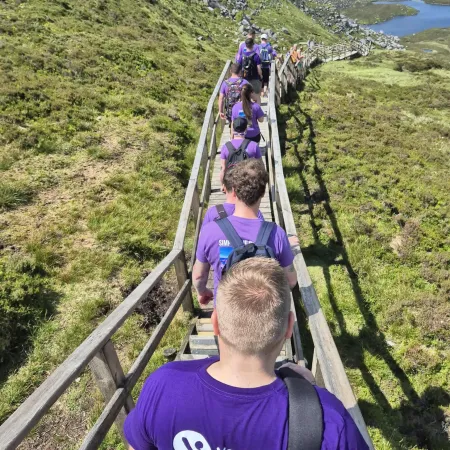
This October, Georgia is taking on Young Epilepsy's 100 Miles in October challenge.
"I wanted to do something positive for Henry and turn what we're going through into something that could help other children and families affected by epilepsy."
Her motivation is simple.
"Every mile is for Henry."
As she works towards her goal, Georgia hopes to raise both awareness and funds for children and young people affected by epilepsy.
"I'm looking forward to reaching that 100-mile target and knowing I've done something to help raise awareness and money for a cause so close to our hearts."
On 14 October, she pushed herself to walk 10 miles in a single day.
"I smashed it!" she says.
Support and finding hope
Supporting Young Epilepsy has become an important part of Georgia's journey.
"When it's your child, you want answers, better treatment options and support from people who understand what you're going through."
She values knowing there are organisations working to support children like Henry and their families.
"Our own journey has shown us just how overwhelming epilepsy can be."
Georgia also hopes that sharing their experiences can help other families who may be facing similar challenges.
"I want Henry's journey to mean something and hopefully help other families feel less alone."
"If sharing our experience helps even one family feel less alone, or encourages someone to learn more about epilepsy, then that means so much to me."

Hopes for the future
Looking ahead, Georgia hopes for greater understanding of childhood epilepsy and continued progress in treatment and support.
Most of all, she hopes Henry grows up knowing how loved he is and how many people are cheering him on.
She also wants him to see the difference that one person can make.
"I'm proud to show Henry one day that even when life is difficult, we can still do things that make a difference."
That belief is what keeps her walking.
"Choose something that means something to you and remember why you started when it gets difficult."
For me it's all for Henry.
A message of hope
Georgia knows there will be difficult days ahead. But she also knows her family is stronger than they ever imagined.
By sharing Henry's story, she hopes more people will understand epilepsy, more families will feel supported and more children living with epilepsy will get the help they need.
"If I can turn some of the hardest things our family has been through into something positive that helps other children and families, then every single step is worth it."