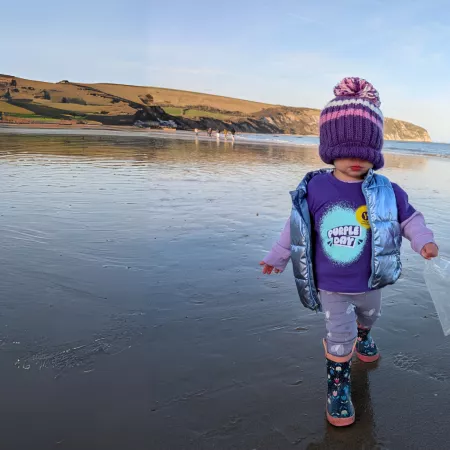
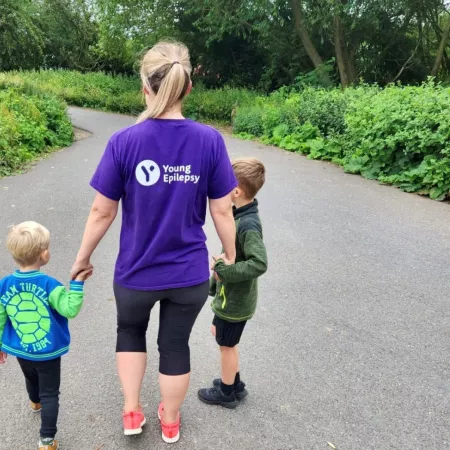
Heather, is a School Business Manager and mum to Wilf, who was diagnosed with epilepsy while attending the school. Their school took part in Purple Day using resources from Young Epilepsy to help raise awareness and understanding of epilepsy among pupils and staff.
When my son Wilf was diagnosed with epilepsy, our whole family felt like we were stepping into the unknown.
I work as a School Business Manager at a small primary school in Cumbria, so I understood how schools operate and the challenges staff face every day. But suddenly I wasn't looking at things through the lens of a school employee. I was looking at them as a mum trying to understand what epilepsy would mean for my child.
At the time, Wilf was the first child in our school to have a diagnosis of epilepsy. Although some of our staff had previous experience supporting children with medical conditions, epilepsy was new for our school community.
The school was incredibly supportive. We received training from local epilepsy nurses, staff learned about rescue medication and seizure first aid, and everyone was keen to understand how they could help Wilf feel safe and included.
But one of the things I quickly realised was that support isn't just about what teachers know. It's also about helping other children understand epilepsy.

Growing confidence through awareness
As time went on, our school introduced epilepsy awareness into a "Mini Medics" session for pupils. It included information about seizures and what children should do if someone has a seizure.
What I loved about it was that it wasn't all focused on Wilf. The epilepsy section was built into wider first aid training, so he didn't feel singled out. His classmates learnt something important, but he still felt like one of the group.
The response was so positive that the school decided to continue the training every year, even after Wilf leaves for secondary school.
For me, that felt like a real achievement. Not because it was about my son, but because it meant future pupils would grow up understanding epilepsy and knowing how to help someone who has a seizure.
Discovering Purple Day
Around the same time, we started using resources from Young Epilepsy.
We used them in assemblies and awareness activities, and that's when Purple Day came onto our radar.
I'll never forget how nervous Wilf was beforehand.
"He just thought nobody would turn up dressed in purple," I remember. "He thought nobody would be interested."
Like many children with epilepsy, there had been moments when his confidence had taken a knock. He'd already been through a lot following his diagnosis, and there was always that worry about standing out or being seen as different.
Purple Day felt like another big step.
The day everyone showed up
When Purple Day arrived, something amazing happened.
The children came to school dressed in purple. They wanted to take part. They wanted to learn more. And they wanted to support their friend.
What had felt like a huge worry beforehand suddenly became a really positive experience.
Children were asking questions. They wanted to understand what epilepsy was and how it affected people. Instead of feeling different, Wilf felt included.
For him, it was proof that people cared.
For me, it showed the power of simply starting conversations.
Sometimes we underestimate children. We worry that they won't understand or won't know what to say. But my experience was the opposite. When children are given the opportunity to learn, they respond with kindness, curiosity and empathy.
It's about more than seizures
One thing I always try to explain is that epilepsy isn't just about the seizure someone sees.
For our family, some of the biggest challenges have been the day-to-day impact of epilepsy, including medication side effects, tiredness and the effect it can have on confidence and wellbeing.
That's why awareness in schools matters so much.
The more teachers, staff and pupils understand epilepsy, the easier it becomes for children and young people to feel supported.
Why Purple Day matters
Looking back, Purple Day gave our school a reason to stop and talk about epilepsy.
It helped children understand a condition they may not have known much about. It helped teachers start conversations. Most importantly, it helped my son see that he wasn't alone.
If there's one thing I'd say to other schools, it's this: don't underestimate the difference raising awareness can make.
A simple assembly, a classroom discussion or a Purple Day activity might seem like a small thing. But for a child living with epilepsy, it can be the moment they realise that the people around them understand, support them and are willing to learn.
For us, that's exactly what happened.