

Anti-seizure medication
Explore anti-seizure medications, their types, side effects, and tips for effective use. Find resources and support for managing epilepsy.
This section covers epilepsy treatments, including anti-seizure medications, vagus nerve stimulation, neurosurgery, the ketogenic diet, and more.
Explore anti-seizure medications, their types, side effects, and tips for effective use. Find resources and support for managing epilepsy.
Learn about epilepsy surgery for children and young people, including different procedures, pre-surgery tests, benefits, risks and seizure outcomes.

Learn about complementary therapies for epilepsy, including homeopathy, aromatherapy, yoga, and more. Doctors do not recommend these treatments.

Learn about ketogenic, modified Atkins, and low glycaemic index diets for epilepsy treatment, improving seizure control for some children.

Learn about cannabis-based anti-seizure medication, including its use in treating specific epilepsy syndromes and its potential benefits for patients.

Learn how different seizure types are treated in children and young people, including medicines, diet and surgery, guided by NICE recommendations.

Learn about ongoing epilepsy treatment, the healthcare professionals involved in your care, and where to find support and advice.
What treatment you have will vary from person-to-person. It also depends on the type of epilepsy you have. Your doctor will explain the main treatment options to you.
The main treatment for epilepsy is anti-seizure medications (meds). Other treatments include:
You may have to try a few treatments, or a combination of different treatments, until you find something that works well for you.
Most people can control and reduce their seizures with the right treatment and support. Anti-seizure meds work very well at controlling seizures. For some people they may help to stop seizures altogether.
Epilepsy cannot currently be cured. But, with the right anti-seizure meds seizures can be reduced, prevented and may stop altogether. If you have not had a seizure for two years, your doctor may suggest stopping or gradually reducing your treatment. Remember to always talk to your doctor before stopping any medication.
If you’ve had a seizure, or you think you may have had a seizure, it’s important to go to your General Practitioner (GP). They will talk to you about your health and any symptoms you’ve had.
If you’ve had a seizure, your GP should refer you to a specialist healthcare professional at the hospital. For example, a children’s doctor (paediatrician). You should have an appointment to see them within about two weeks. But it can sometimes take longer. They will talk to you in more detail about your health and may suggest doing some tests. This will help them decide if you have epilepsy.
If you are diagnosed with epilepsy, your specialist doctor will talk to you about the treatment options. They will work out a treatment plan with you. They will use the National Institute for Health and Care Excellence (NICE) guidelines to help work out which treatments to offer first. You will usually start with one treatment. Your doctor will suggest other options if the first treatment doesn’t work. Or if you have side effects that are difficult to manage.
The NICE guidelines are a set of trusted recommendations for how health and care should be delivered to people in England and Wales. NICE stands for National Institute for Health and Care Excellence.
Your healthcare team will use these guidelines to help them make decisions about your health, including what treatments you may have.
NICE create guidelines for all types of health problems, including epilepsy in adults, children and young people. To read the full guidelines for children and young people with epilepsy, visit the NICE website.
If you live in Scotland, your healthcare team may use SIGN guidelines. SIGN stands for Scottish Intercollegiate Guidelines Network. They are used in the same way as NICE guidelines. To read the full guidelines for children and young people with epilepsy, visit the SIGN website.
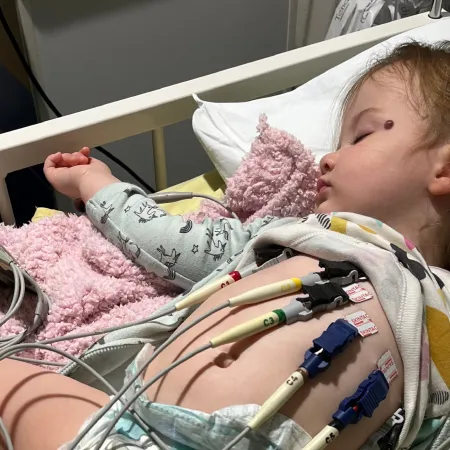
Lilly is four and lives with complex epilepsy. Read her family’s story and see how your support helps children like Lily feel safer, supported and hopeful.

From 30 seizures a day to living life fully – discover Liberty’s remarkable epilepsy journey and the breakthroughs that changed everything.

Read Lisa’s story about seizure control, sodium valproate and the difficult choices epilepsy can bring around independence and family plans.
1. Epilepsy. nhs.uk. October 23, 2017. Accessed January 20, 2026. https://www.nhs.uk/conditions/epilepsy/
2. Epilepsy. Accessed January 20, 2026. https://www.who.int/news-room/fact-sheets/detail/epilepsy
3. Chen Y, Li W, Lu C, et al. Efficacy, tolerability and safety of add-on third-generation antiseizure medications in treating focal seizures worldwide: a network meta-analysis of randomised, placebo-controlled trials. eClinicalMedicine. 2024;70. doi:10.1016/j.eclinm.2024.102513
4. Epilepsy. nhs.uk. October 23, 2017. Accessed October 8, 2024. https://www.nhs.uk/conditions/epilepsy/
5. Heenan N, Coleman K, Tittensor P, Shepley S. Epilepsy in Children and Young People. Karger; 2024.
6. NICE. Epilepsies in children, young people and adults. Published online 2022.
This information was written by:
This information was reviewed by:

Young Epilepsy’s information on epilepsy causes – genetic, metabolic, unknown and in infant epilepsy

Learn about common childhood and rare infancy epilepsy syndromes in this informative guide from Young Epilepsy.

Understand epileptic seizures, their types, causes, and management. Find resources and support for living with epilepsy.

Find out how epilepsy is diagnosed, what to expect at your first appointment, and how to get the right support for children and young people.
Explore common co-occurring conditions like autism, ADHD and dyspraxia in children with epilepsy, and how to recognise and support them early.

Learn about SUDEP, who is at risk, and how to reduce the chances of epilepsy-related death in children and young people through safety and support.
Access resources and strategies for transitioning adolescents with epilepsy to adult healthcare. Learn how to manage this important phase effectively.
Last reviewed: July 2026
Next review due: July 2029
If you would like to find out more about how we produce our health information, please check out Young Epilepsy is PIF TICK certified | Young Epilepsy or contact us at healthinfo@youngepilepsy.org.uk.


Do you have a question about our work? Please click on the link to find out the best person to email or call.