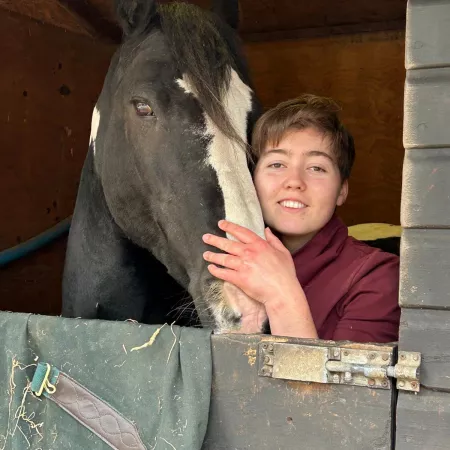
When Liberty was just four years old, her life changed dramatically. What began as tiny cramps in her right calf quickly escalated into full tonic-clonic seizures. Within months, she was having up to 30 seizures in a single day.
Walking became almost impossible as her muscles fatigued, and she faced cognitive challenges and incontinence. Everyday activities suddenly became unsafe, and her quality of life plummeted.
Doctors were baffled. Despite multiple medications, nothing worked. EEGs suggested the seizures were focal, starting in the same place each time, but the cause remained a mystery.
Everything changed when Liberty was seven. A high-resolution MRI at St George’s Hospital revealed a subtle lesion in her brain’s motor strip – a condition called cortical dysplasia. This congenital abnormality had only started causing problems when Liberty’s neural pathways developed at age four. The discovery opened the door to epilepsy surgery, offering hope for fewer seizures.

That hope was short-lived. Great Ormond Street Hospital deemed surgery too risky because the lesion sat in an “eloquent” part of the brain responsible for movement. Operating could leave Liberty paralysed on her right side.
It was devastating news for a little girl already living with severe disability.
But Liberty’s story didn’t end there.
Her paediatrician, Dr Matthew Lee, referred her to Dr Elaine Hughes at King’s College Hospital, who in turn introduced her to neurosurgeon Mr Richard Selway. He believed Liberty’s young brain had enough plasticity to recover from surgery.
The team began cautiously with an intracranial EEG, placing electrodes in Liberty’s brain to monitor seizures over 10 days. The data confirmed the lesion’s location and the complexity of the case. It was an agonising decision, but Liberty and her family chose to go ahead. Using thermal coagulation, surgeons burned away a small number of epileptic cells.
The result was life-changing. Liberty was seizure-free for two years and regained full function – you’d never have guessed what she’d been through.

Sadly, the seizures returned when Liberty was 13, though less aggressively. Another round of thermal coagulation reduced them again, but this time she lost some movement and sensation in her right hand and leg. It was a difficult trade-off, but Liberty would tell you it was worth it.
Today, Liberty is 17 years old and only has seizures at night. She’s back doing what she loves – horse riding, rowing, and studying animal care at Merrist Wood College. Further surgery is an option, but it would mean being awake during the procedure and carries high risks.
I can finally do the things I love again – riding, rowing, and caring for animals. It’s been a tough road, but I’m proud of how far I’ve come.
Liberty’s journey shows the courage it takes to balance medication, surgery, and hope. It’s a story of resilience, determination, and the incredible skill of the medical teams who never gave up.