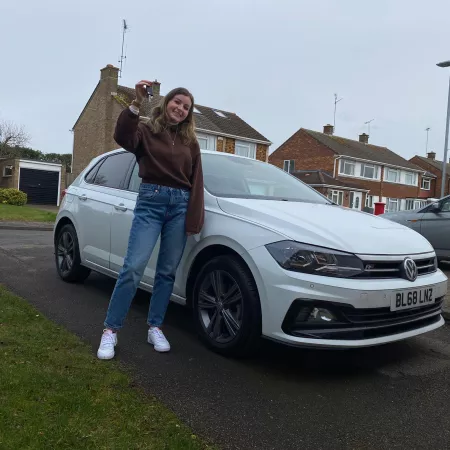
Molly is a long jumper, a Paralympic athlete, and a young woman living with epilepsy and cerebral palsy. After losing her licence, her independence and nearly her sport, Molly reached a turning point. Now seizure‑free again, she speaks openly about loss, grief and finding strength in the small wins.
Growing up with disability and epilepsy
Molly was diagnosed with epilepsy at 14, during puberty. At the time, she was already living with cerebral palsy, which affects the left side of her body.
“I was kind of like, okay, add that on to the list,” she says. “Why not?”
Her early seizures happened while she was asleep. She shared a room with her sister, who was often the first to notice something was wrong.
“I had no idea what was going on,” Molly says. “It was scarier for my family than for me, because I wasn’t conscious.”
Her parents learned quickly how to respond. Over time, the family put extra safety measures in place, including a baby monitor and a bed sensor.
“They just wanted something to help,” Molly says. “I didn’t really want it at first, but looking back, it made a huge difference.”
Sport gave her focus
Alongside hospital visits and medication, Molly had another big part of her life. Athletics.
She competes as a long jumper and has represented her country at major events. Sport gave her confidence and something to aim for.
“It was always my goal,” she says. “Athletics was the thing that kept me here, kept me focused.”
For years, her seizures were controlled. She drove, trained and lived independently. Then everything changed.

When everything changed
In March 2023, Molly had her first seizure while awake.
“I was ten minutes away from getting in the car,” she says. “Then my arm started moving, and next thing, I was gone.”
That seizure marked the start of one of the hardest periods of her life. She lost her driving licence and had to change medication completely.
“I lost my independence. I was on the verge of quitting my sport. I was at my lowest.”
The medication changes were tough. Seizures returned. Some happened in her sleep. Others sent her to hospital.
I was worrying all the time. Anxious. Scared. Feeling like no one really understood.
Grief made everything heavier
Six months before her seizure, Molly lost a close friend to SUDEP.
“It broke my heart,” she says. “I still think about him every day.”
The loss changed how she saw epilepsy.
“I didn’t realise how serious epilepsy could be until I lost my friend,” she says. “It’s so unspoken about.”
That grief sat alongside her own fears while her seizures were out of control. Still, she kept going.

One goal at a time
Getting her seizures back under control took time. Molly worked closely with her medical team and stuck to a strict routine.
“Eight in the morning, eight at night. Every day,” she says. “That routine helped me feel like I had some control again.”
In September 2024, Molly reached a huge milestone. One year seizure‑free. Soon after, she got her driving licence back.
“That changed everything,” she says. “My mental health, my sport, just how I felt about myself.”
With her licence came freedom. And hope.
Sharing the reality online
Molly now shares her life openly on social media. Not to gain attention, but to reach the people who need it most.
“If one post helps one person, then I’m happy,” she says. “Even one comment is enough.”
She talks honestly about epilepsy, cerebral palsy and mental health. She shows the good days and the hard ones.
“Life is difficult,” Molly says. “If someone sees my post and feels less alone, that matters.”
Looking forward with honesty
Today, Molly is back training and competing. She has her eyes on future championships and takes each day as it comes.
“There is a light at the end of the tunnel,” she says. “Everyone’s journey is different, but you can live a life with epilepsy.”
She knows there may be challenges ahead. But she also knows what she is capable of.
Epilepsy is part of me. Not something I have to live under.
Molly’s story is a reminder that progress does not always look big or fast. Sometimes, it is taking your medication on time. Sometimes, it is showing up anyway. And sometimes, it is sharing your story so someone else feels understood.