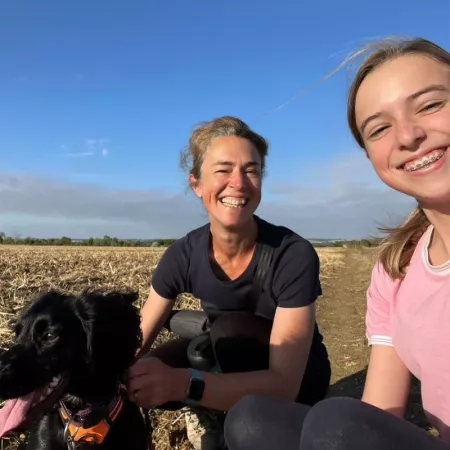
When Lucy and her husband found out that their daughter Penny had epilepsy, it changed life for their whole family.
Today, Lucy is using her experience to help other families and create opportunities for young people with epilepsy. This includes working with Young Epilepsy to run a careers event through SHMA, the firm where she works.
For Lucy, the event was about more than careers. It was a chance to show young people that epilepsy does not define who they are or what they can achieve.
Meet the “Fab Five”
Lucy lives in Stafford with her husband and their three children: Daisy, Penny and Oscar.
“We’re quite a close-knit family,” Lucy says. “We call ourselves the Fab Five.”
Penny is five and has epilepsy, cerebral palsy and autism. Lucy also experienced epilepsy when she was younger, but her own seizures were controlled with medication and had less impact on her everyday life.
This meant epilepsy was not completely new to Lucy when Penny was diagnosed. At first, the family focused more on Penny’s cerebral palsy and developmental delays.
But as Penny grew, the impact of her epilepsy became clearer.
“It’s the elephant in the room that you just can’t work around, because it’s so unpredictable,” Lucy says.

Living with the unknown
Penny experiences different types of seizures. Some are difficult for other people to notice. During an absence seizure, she might stare into space before carrying on with what she was doing. She also experiences seizures that involve repetitive movements and tonic-clonic seizures.
No two days are the same.
“It is all of her day-to-day life,” Lucy explains. “It’s that unknown. I hate the unknown.”
Penny’s changing needs mean the family must regularly update plans, speak to health professionals and make difficult decisions. Lucy keeps her phone with her during work meetings because a call from Penny’s school or her husband could mean that Penny has had a seizure and needs to go to hospital.
“You’re in that continual state of living on the edge,” she says.
Penny is currently receiving specialist care and being assessed to find out whether epilepsy surgery could be an option. Lucy says more information about how specialist care works would have helped the family feel better prepared.
She also believes families need clear, sensitive information about epilepsy risks, including Sudden Unexpected Death in Epilepsy, known as SUDEP.
Having this information can be frightening. But Lucy feels that honest conversations can help families understand their options, ask questions and make informed choices.
Epilepsy will always be a big part of life, but it doesn’t define you.
Supporting the whole family
Epilepsy has affected everyone in Lucy’s family.
One of the hardest things is knowing how much information to give Penny’s siblings. Lucy wants them to understand what is happening, but she also wants them to enjoy being children.
Daisy, Penny’s older sister, is naturally caring and protective. Lucy describes her as a “mother hen” who wants to look after Penny.
“You don’t want to stop that,” Lucy says. “They’ve got a really lovely bond. But it’s trying to find that line of saying, ‘Daisy, this is a bit too much for you. You are seven. Mummy and Daddy are going to deal with this.’”
Penny’s siblings also help build her confidence. She wants to do the things that Daisy and Oscar do, and they encourage her to keep trying.
When Penny says she cannot do something, Daisy tells her: “Don’t be silly, Penny. Of course you can. Come on, let me help you.”
Lucy believes this support has made a real difference to Penny’s development.
“Her siblings are a massive driver for her,” she says. “They give her the confidence that she is no different.”

Finding information and support
When Penny was diagnosed, Lucy wanted more information about the support available and how to access specialist care.
Young Epilepsy was one of the main places her family turned to.
“When we were first looking at how we could get help, Young Epilepsy was one of the main charity pages we looked to for information,” she says.
Lucy’s advice to other parents is to learn about epilepsy and find people who understand what they are experiencing.
“Education and knowledge are power. They give you the comfort of knowing and understanding the condition a little better.”
She also encourages parents and carers to look after themselves and find someone they can speak to openly.
“Unless you’re in this situation, you don’t get it,” she says. “It’s really important to find somebody who does, or at least somebody who will listen.”
That support does not have to be complicated. For Lucy, taking time to have her nails done gives her the chance to talk and recharge.
“You’ve got to find something,” she says. “Then you’re ready to go again.”

Creating career opportunities with SHMA
Lucy’s family experience has strengthened her determination to support other people affected by epilepsy.
She was inspired to organise the careers event after reading about the barriers someone with epilepsy had faced when applying for jobs. Through her role at SHMA, Lucy saw an opportunity to offer practical support.
Young people met professionals and discussed applications, workplace rights and how to talk about epilepsy with an employer.
The event also encouraged them to recognise the skills they already have.
Lucy explained that a young person might not have completed traditional work experience because of hospital appointments or the demands of managing their epilepsy. However, living with the condition may have helped them develop valuable skills.
“You’ve already learned how to work with your consultant, so you know how to work as a team,” she says. “You know what to do in a crisis. Those are amazing qualities to have.”
For Lucy, one of the highlights was seeing the young people’s confidence grow.
“By the end, they were giving the answers,” she says. “It was really nice to be able to talk about things other than epilepsy. Their lives have revolved around this condition, but it doesn’t define them.”
Following the event, some of the young people contacted Lucy with further questions. SHMA is also exploring possible work experience opportunities, and Lucy hopes the partnership can offer more careers support in the future.

Looking beyond fundraising
The event did not raise money. That was never its purpose.
Instead, SHMA shared its time, professional knowledge and experience. It created a space where young people could ask questions, build confidence and think about their future.
Lucy hopes more employers will get involved and help young people understand the different routes into work, including work experience and apprenticeships.
She also wants employers to learn more about epilepsy and speak to employees about the support they might need.
“It’s not just what you see on TV,” Lucy says. “It’s not just a tonic-clonic seizure. Epilepsy can affect so many areas of someone’s life.”
Her message to others is simple: learn what epilepsy means for the individual and ask what you can do to help.
“It’s not something to be scared of,” she says. “You just need to be supportive.”

Living life on their own terms
There is no simple way to remove the uncertainty epilepsy brings. But Lucy is determined that fear will not stop Penny or the rest of the family from experiencing life.
“You have to make that decision,” she says. “Do you allow it to control you, or do you put things in place and go for it?
“I want Penny to manage her condition, but I also want her to go out, enjoy things and experience things.”
Through her family’s story and her work with Young Epilepsy, Lucy hopes other young people will hear the same message she shared at the careers event:
Epilepsy is part of your life, but it does not define who you are or what you can bring to the world.