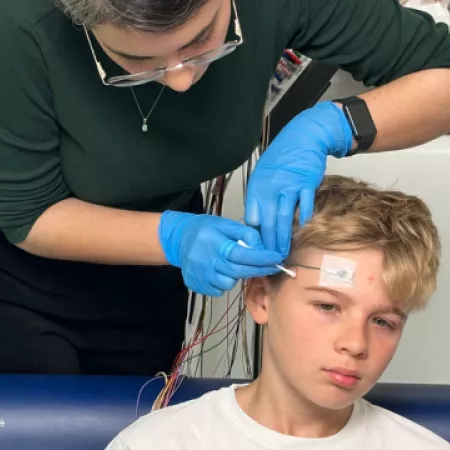
Although I’d been living with epilepsy for years, it wasn’t until the tests and hospital admissions started to play a bigger role that everything changed. Like most people, my attention was on everyday life and looking ahead to the future.
Over time, epilepsy began to have a bigger impact. Medications weren’t giving clear answers, and my medical team started talking to me about more detailed tests to understand my seizures better.
That was when I was told I might need an intracranial EEG - a specialist test that records brain activity using electrodes placed inside the skull. It would help my doctors understand exactly where my seizures were coming from and whether surgery or other treatments could help.

Understanding what was happening
At the time, I didn’t fully understand where this test sat in the bigger picture. Looking back, I think that’s one of the most important things to be clear about.
The intracranial EEG wasn’t a treatment. It wasn’t designed to stop my seizures or change how I felt day to day. It was an assessment - something doctors use to gather more information before making decisions about future care, including whether surgery could be an option.
Even knowing that, agreeing to it wasn’t easy. It felt like a big step, and there was a lot of uncertainty. But I wanted answers. I wanted to understand my epilepsy better and know what options might be available.
Being in hospital for assessment
I ended up spending a long time in hospital while my brain activity was monitored. What surprised me most wasn’t just the test itself, but everything around it.
Being in one room for weeks. Being constantly monitored. Losing independence. These things take a toll, especially when you don’t know what the outcome will be.
It wasn’t just physical - it was emotional. Days could feel long and repetitive. Not knowing what was coming next made it harder.
I don’t think I was fully prepared for how intense that would feel, even though I understood why the assessment was needed.
What I found hardest
Some parts of the experience were more difficult than I expected. Not because no one cared - the staff were supportive - but because I didn’t realise how much the everyday things would matter.
Independence. Privacy. Time passing slowly. Being away from my family, including my family, who was only a month old at the time.
Those are the things I wish I’d been more prepared for, rather than the medical detail.

Getting through it
What helped me most was knowing I wasn’t doing it for nothing. The assessment had a purpose: to help doctors understand my epilepsy better and to guide future decisions.
Support made a big difference too. Having visitors. Staying connected to people outside the hospital. Finding small ways to cope with boredom and uncertainty.
Over time, I gained some perspective. I realised I could get through something I never thought I’d manage. That didn’t make it easy - but it did build resilience.
Looking ahead
I’m now waiting for the results of the assessment, which will help decide what happens next. Surgery may be an option, or it might not. There are no guarantees.
I still feel nervous about the future, but not in the same way as before. Having gone through the assessment process, I feel more informed and more prepared for whatever comes next.
There’s also hope. Not certainty - but hope that understanding my epilepsy better could lead to better care.
What I wish I’d known
If I could say one thing to someone facing a similar assessment, it would be this:
Ask about how the experience might affect you day to day, not just medically.
It’s okay to want information without wanting every detail. It’s okay to feel scared. And it’s okay to take things one step at a time.
Everyone’s epilepsy journey is different. This was mine. And while it was hard, I’m glad I took the step to find out more.