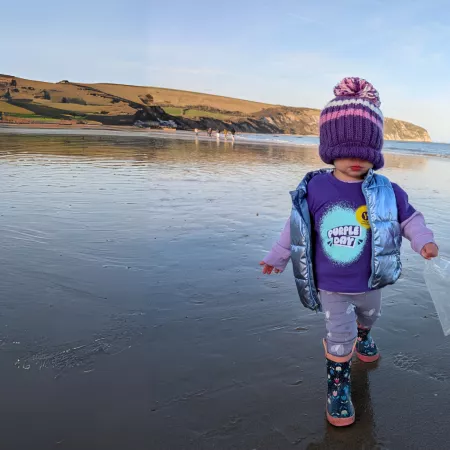
Frank is seven and full of life. He loves Roblox, being active and making people laugh. But when night falls, his world becomes more uncertain. Frank lives with epilepsy and other complex needs, and his seizures happen mostly while he sleeps. His mum, Catt, shares their story of being unheard, holding onto hope, and the quiet strength of family.
“I knew something wasn’t right”
Frank had his first seizure in September 2022. It did not stop, and Catt made the decision no parent ever wants to make, calling an ambulance and rushing him to hospital. At the time, the seizure was put down to a convulsion caused by a temperature, and the family were sent home.
But Catt knew in her gut that this was not the full story.
“When he came round, he didn’t know who I was or who his dad was,” she explains. “As a parent, that stays with you. I just knew it wasn’t right.”
Over the following months, Frank continued to have seizures. Mostly they happened at night, when the rest of the world was asleep. Sometimes they were long. Other times they came in clusters. From December 2022 onwards, the seizures were happening almost every night, leaving Frank exhausted and his family living in a constant state of vigilance.
During this time, Catt repeatedly raised concerns but was given mixed messages.
“One doctor said it was epileptic. Another said it was normal night-time movement,” she says. “I just kept saying, it’s not normal.”
“They forgot to refer him”
Frank was finally diagnosed with epilepsy in March 2025, more than two years after his first seizure. That delay was not because the seizures stopped, but because his referral to the epilepsy team was never sent.
“For six months, I was sat at home waiting,” Catt says. “I kept thinking, when is he going to be seen properly?”
Eventually, she rang the epilepsy team herself. What she was told left her shocked.
“They said, ‘We’re so sorry, the referral was never sent.’”
During those months, Frank continued to have seizures and Catt was left without answers, treatment or support. Over time, the experience began to wear her down.
“They made me doubt myself,” she says. “I started questioning whether I was imagining it. When the people who are meant to help you make you doubt your instincts as a parent, that’s incredibly hard.”
At one point, Frank was close to being discharged altogether. It was only with support from family members stepping in and reinforcing what Catt was seeing that she found the strength to keep pushing for answers.

Life without sleep
Frank’s epilepsy is mostly nocturnal, which brings its own challenges. He also has breathing difficulties and is being assessed for sleep apnoea, adding another layer of risk and anxiety.
“I don’t really sleep,” Catt says. “I can maybe sleep between ten and midnight, when I feel like he’s in a safe window. After that, I’m awake.”
Frank wears monitoring equipment at night, including alarms and cameras, but that does not remove the worry.
“I can’t just rely on machines,” Catt explains. “It has to be me. I need to be listening to his breathing and checking he’s OK.”
The lack of sleep has a huge impact on Frank too. After a night of seizures, he wakes up exhausted and can struggle to regulate his emotions.
“He gets headaches and can feel completely overwhelmed the next day,” Catt says. “People look at him and think he’s fine, but they don’t see what’s happened overnight.”
“Epilepsy is not just the seizures”
Frank also lives with a chromosomal condition and other needs, including anxiety, hypermobility, low muscle tone and traits of ADHD and autism. Together, these shape how he experiences the world, especially when epilepsy is layered on top.
At school, Frank has an individual care plan, but Catt feels there is still a lack of understanding about epilepsy beyond what seizures look like.
“They see epilepsy as big seizures,” she says. “They don’t always understand the after-effects. If he’s struggling the next day, it can be seen as behaviour, when actually he’s exhausted and overwhelmed.”
Even school events can feel frightening. Catt remembers watching Frank take part in a school play where he was asked to stand up and down on a bench.
“I was sat there panicking,” she says. “All I could think was, if he seized from that height. It felt like the risk hadn’t been properly thought through.”

The unseen impact on siblings
Frank shares a bedroom with his older sister, Tiff. She has witnessed seizures that no adult has seen and carries an emotional weight that often goes unnoticed.
“Siblings are the unseen victims,” Catt says. “She sees and hears far too much.”
Tiff has helped Frank during seizures, putting him into the recovery position and calling for help when she has been scared herself. Despite this, she shows a level of awareness and compassion well beyond her years.
“She’s often the first to notice when something isn’t right,” Catt explains. “She steps in to protect him, especially at school. She worries about him being misunderstood or excluded.”
Catt pauses when she talks about her daughter.
“There’s a quiet strength holding Frank up every day and that’s his sister.”
A boy full of joy
Despite everything, Frank remains joyful and full of life. He loves Roblox, YouTube, exercise and being around people. He has an infectious sense of humour and a natural confidence.
That confidence shone through on Purple Day, when Frank shared his story with his school and took part in raising awareness.
“He felt accepted,” Catt says. “He said all the boys and girls watching were just like him.”
Seeing how Frank handles everything fills his mum with pride.
“He just gets on with it,” she says. “Some children really struggle. Frank just grabs it and keeps going.”

Finding support through Young Epilepsy
Catt reached out to Young Epilepsy after feeling frightened and alone. She had been given information without explanation and left to process it by herself.
“When you’re handed leaflets and sent home, it changes you,” she says. “Reading things like that without anyone to talk to is terrifying.”
Through Young Epilepsy, Catt found clear information, reassurance and, most importantly, the sense that someone was finally listening.
“For the first time, I felt seen and heard,” she says.
As Frank gets older, he will be able to access youth services and meet other young people who understand what living with epilepsy really means.
“There is hope”
Recently, Frank reached a milestone that once felt impossible. He completed his first full week seizure-free in more than three years.
“I never thought we’d get here,” Catt says. “But here we are.”
The journey is not over, but there is now space for hope. When Catt thinks about other parents at the beginning of their journey, one message stays with her.
“Trust yourself,” she says. “Do not let anyone make you feel less for pushing for answers. There is hope. It might take time, but it is possible.”