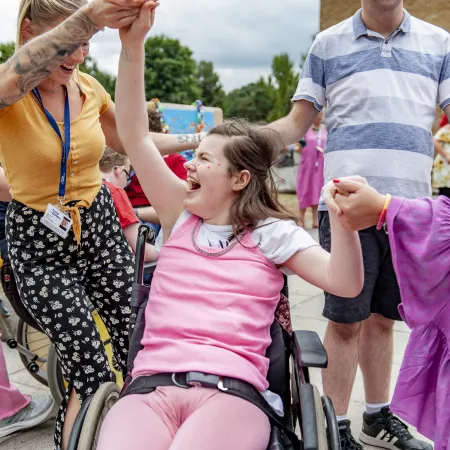
When Alwen Eidda’s daughter Neli was diagnosed with epilepsy, life changed overnight. But instead of retreating, Alwen stepped forward - literally, by joining Young Epilepsy’s Walk 100 Miles in October Challenge. Together with money donated for her husband’s 50th birthday, she has raised over £2,300.
Walking 100 miles
Alwen has always been drawn to challenges - she was doing an Ultra Challenge the weekend her daughter Neli had her first seizure. So when she saw Young Epilepsy’s “Walk 100 Miles in October” campaign, it felt like the right fit.
I’ve got to have a challenge at any one point in my life. It helps me keep moving. The pressure’s on now because of how much people have given!
A shock on the farm
But earlier this year, the challenge was of a very different kind: the discovery that Neli, Alwen’s third daughter, had epilepsy. She was nine when a first seizure happened suddenly while visiting her grandmother on a farm in the Isle of Man.
It threw the family into confusion.
She was taken to hospital by ambulance and they found a bleed on the brain. They still don’t know if the bleed happened because of the fall, or if she fell because of the seizure.

After a few days of observation, Neli was discharged and returned to her usual routine. The doctors reassured Alwen that many people have a seizure once in their lives and never again. But two weeks later, Neli had another seizure, this time on her parents’ farm while helping load hay.
She fell into a trailer full of hay. So she couldn’t have asked for a better landing!
Diagnosis and daily life
Following the second seizure, Alwen drove Neli to Alder Hey Children’s Hospital. There, Neli underwent an MRI and EEG. The diagnosis was confirmed: generalised epilepsy, with both tonic-clonic and absence seizures.
Since April, Neli has had eight seizures. They’ve happened in cafés, cars, and on the farm; never at school, and never with a predictable pattern. The family has learned to spot signs of exhaustion or emotional overwhelm, which sometimes precede an episode.
Neli’s independence has been affected. She can no longer ride her quad bike alone or fetch sheep without supervision. The family has had to adapt, balancing safety with her need for freedom.
You don’t want her to feel someone is watching her all the time. That’s the hardest thing for me
But Neli is still pursuing a keen love of rugby.
It’s a massive thing here, and the doctors said it’s the best thing to have the exercise and the physical movement she needs as a child.
Family resilience
The whole family has rallied around. Neli’s older sisters, Myfi and Elsi, have learned how to respond to seizures and help with care. Even four-year-old Beti has picked up the signs.
She’ll shout ‘seizure!’ when she sees Neli having an absence. We applaud her for doing that.

They’ve had open conversations around the kitchen table, discussing what to do and how to stay calm. Humour plays a big role.
We joke about it. You have to. You don’t want them to be scared.
As Neli prepares to move to secondary school, Alwen is both hopeful and anxious. The small primary school offered constant supervision, but high school will be different.
I’m hoping her friends will look out for her. We’ve talked to their mums. They know what’s going on.
Finding Young Epilepsy
Alwen discovered Young Epilepsy not through the hospital, but through her own research. She was looking for practical tools, like seizure-alert devices, and stumbled across the charity’s website.
It was the first help I had as a parent. The hospitals gave medical advice, but not practical support.
She signed Neli up for the Young Epilepsy forum, though she’s unsure how her daughter will respond. Face-to-face groups would be better, Alwen believes, especially for children like Neli who aren’t used to online interaction.
I’ve asked the epilepsy nurse if there are any groups in Wales. But there’s nothing.

Turning to fundraising
Alwen combined the walk with her husband Hywel’s 50th birthday party, asking guests to donate instead of bringing gifts. The fundraising total quickly grew, from an initial target of £450 to over £2,300.
She’s doing the walk across North Wales and even plans to continue while on holiday in Dubai. Young Epilepsy has supported her with personalised messages, a T-shirt, beanie, and tracking materials.
They make it feel personal. You’re not just a number.
Looking ahead
And the fundraising is, she says, more than just raising money: it’s about connection, empowerment, and hope. She wants to see Young Epilepsy continue to support families like hers, especially with practical resources and local networks.
The experience has changed her, not just as a mother, but as a person.
When you’re doing it for a personal cause, it means so much more. It comes from deeper down.