See it.
Notice a safeguarding or data protection concern. A worry. A risk. A potential breach.

This page is for staff, volunteers, contractors and visitors and sets out what to do if you have a safeguarding or data protection concern. If in doubt, REPORT IT!
Across the organisation, teams already do a great job keeping children and young people safe and handling information responsibly.
See it. Hear it. Act on it. builds on that strong foundation. It brings together what we already do well and makes it clear, visible and consistent for everyone, whatever your role or working pattern.
The aim is simple: to make sure everyone feels confident, supported and clear about acting early when something doesn’t feel right.
Click here: safeguarding reporting process Click here: data protection reporting process
If in doubt, REPORT IT!
Keep young people safe and information secure.
Notice a safeguarding or data protection concern. A worry. A risk. A potential breach.

Listen carefully when someone raises a concern. Take it seriously, without judgement or delay.

Respond quickly and follow the procedures. Report factually, accurately and promptly.
Safeguarding and data protection are part of the great work already happening across the organisation, not just in front‑line roles.
If your role touches children, young people, data, content or systems, safeguarding applies to you. Every role plays a part in maintaining trust, safety and protection.
Safeguarding
Data protection

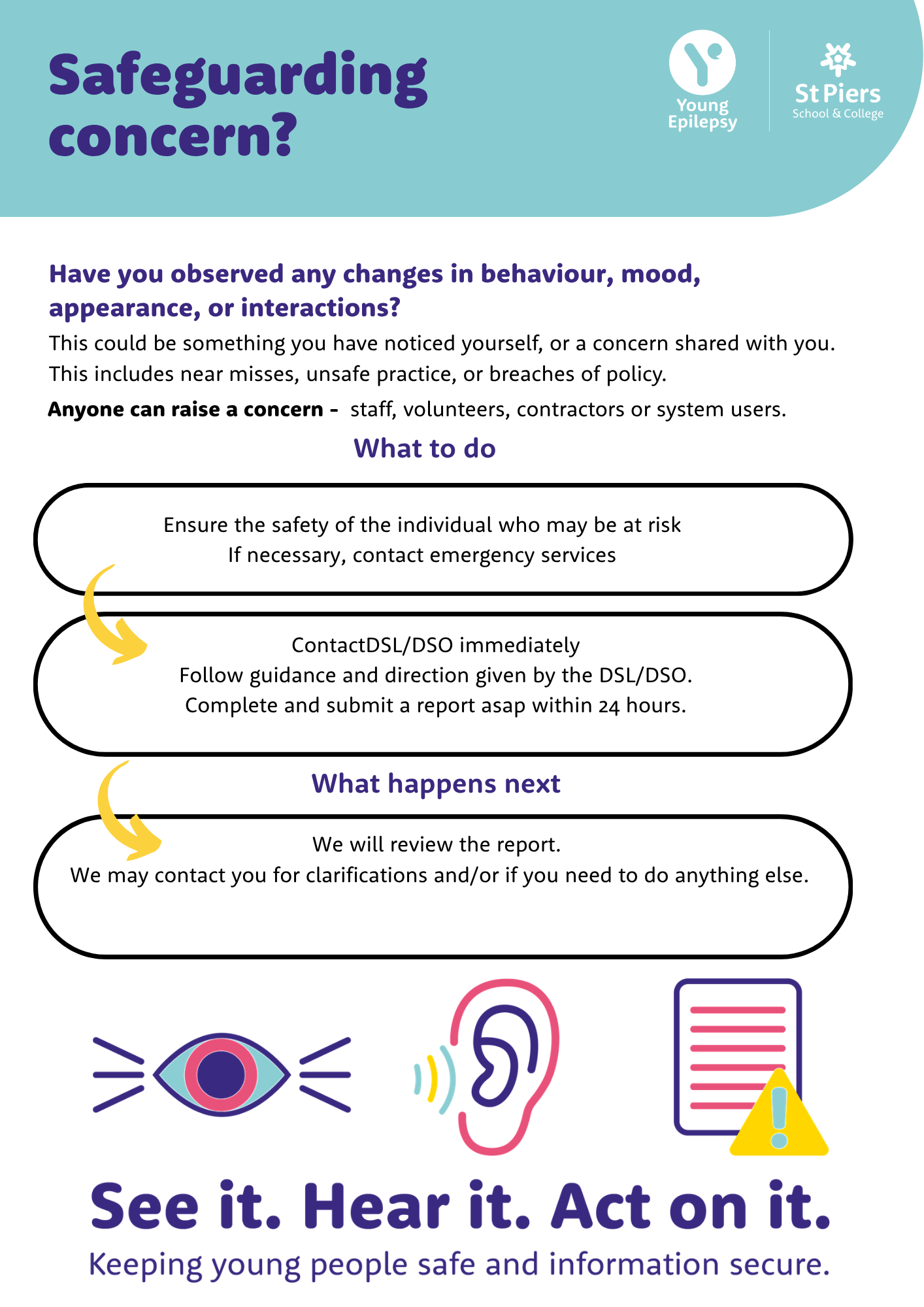
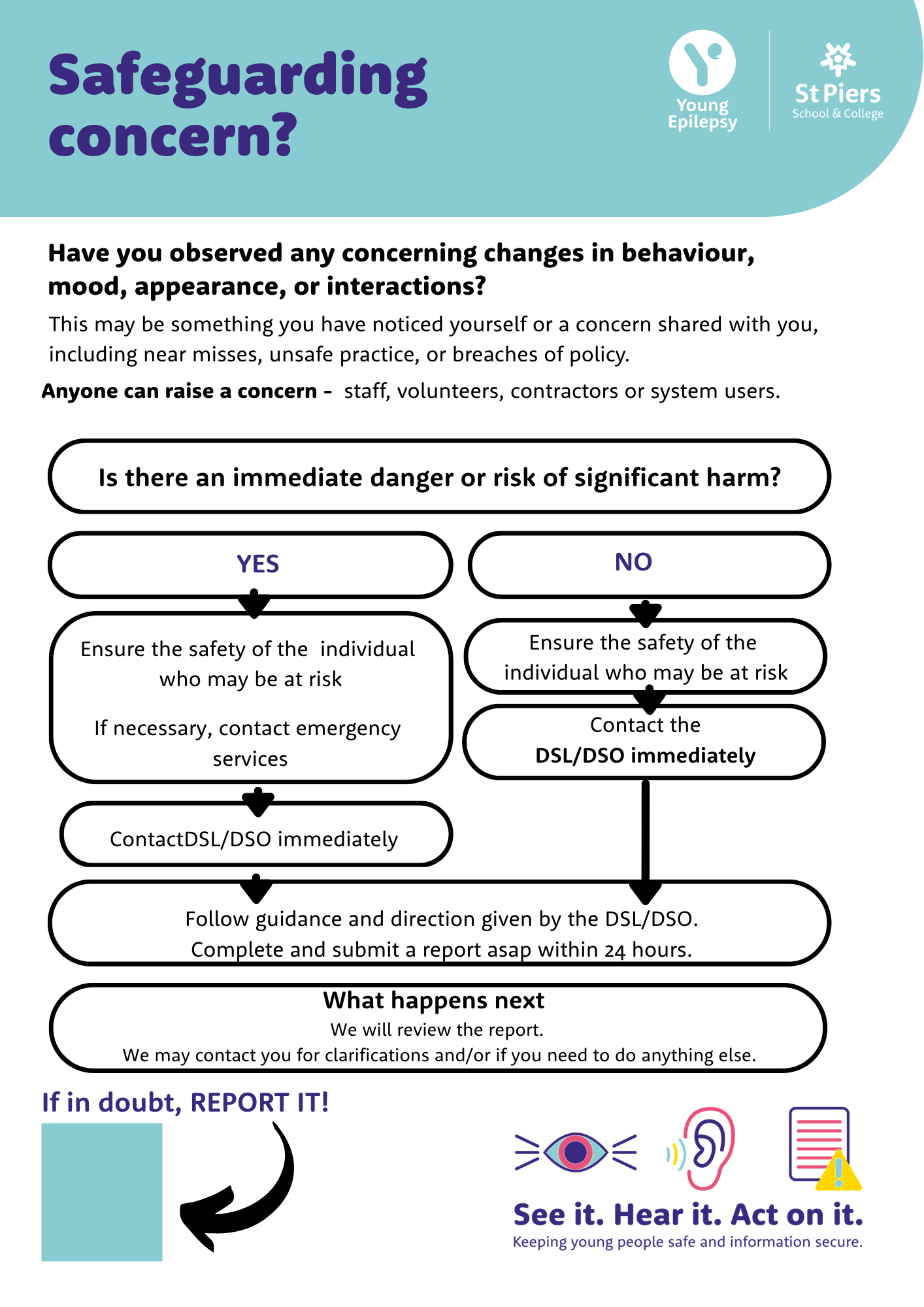
Have you observed any concerning changes in behaviour, mood, appearance, or interactions?
This may be something you have noticed yourself or a concern shared with you, including near misses, unsafe practice, or breaches of policY.
Anyone can rise a concern - students, serve users, staff, volunteers, contractors, visitors.
Click here for Safeguarding reporting process
The Designated Safeguarding Lead (DSL) is the person with overall responsibility ensuring safeguarding is effective across St Piers.. They provide strategic oversight and ensure the organisation meets its legal (statutory) safeguarding duties.
There is a named Lead DSL in place, as required by law, who has ultimate accountability for safeguarding arrangements.
The Deputy Designated Safeguarding Lead (DDSL) provides day‑to‑day safeguarding advice, support and first response within specific service areas at St Piers. They work closely with the DSL to ensure concerns are acted on promptly and appropriately.
For simplicity, documents may refer to ‘DSL’ collectively, but the Lead DSL role remains distinct and has statutory responsibility.
The Designated Safeguarding Officer (DSO) provides day‑to‑day safeguarding advice, support and first response within specific Young Epilepsy service areas. They work closely with the Lead DSL to ensure concerns are acted on promptly and appropriately.

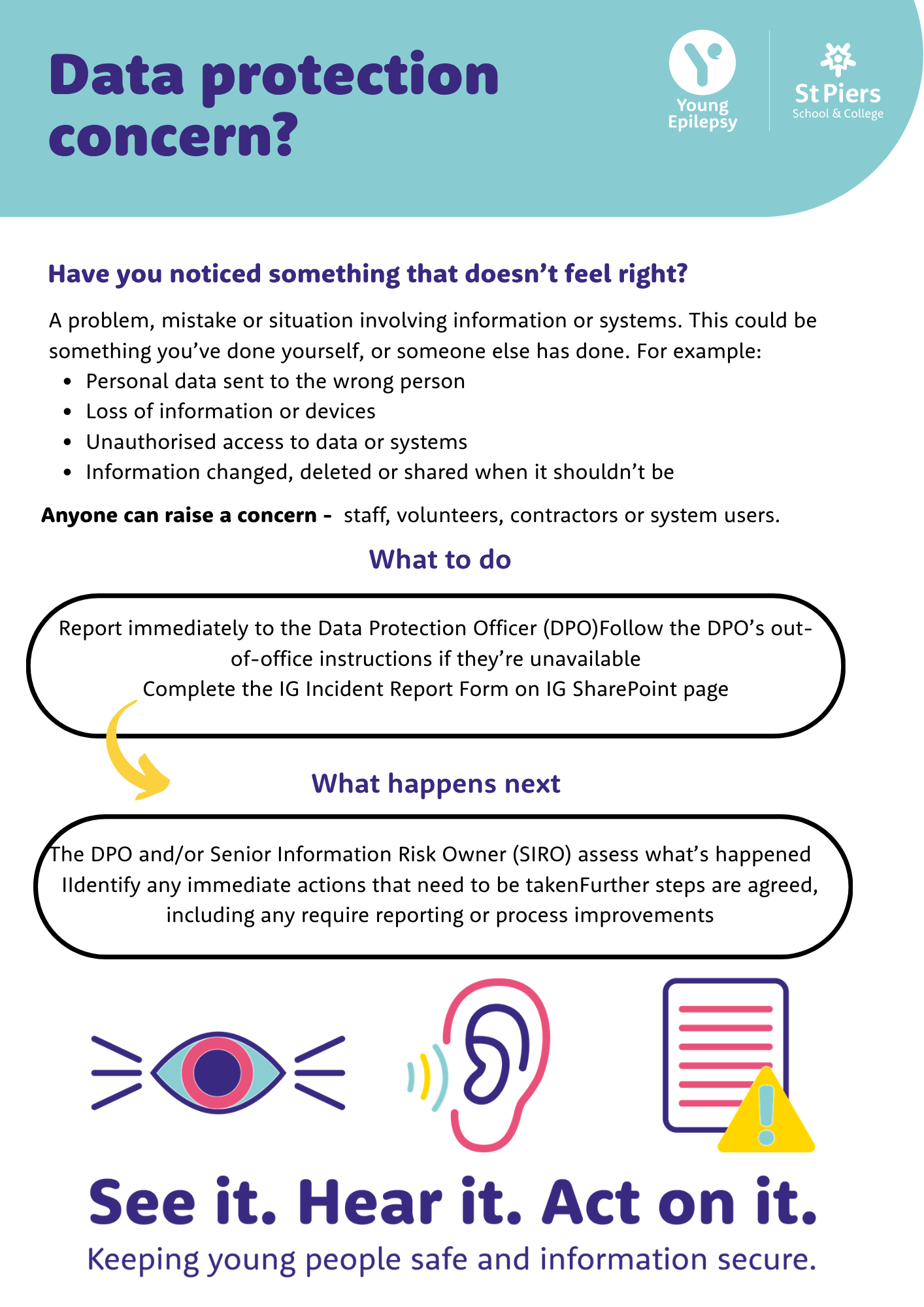
A problem, mistake or situation involving information or systems. This could be something you’ve done yourself, or someone else has done. For example:
Click here for Data Protection reporting process
For this campaign, we’re using data protection as a clear, everyday way of talking about information governance.
In practice, data protection includes how we look after:
It’s about handling information safely, respectfully and responsibly, just as we would expect for ourselves.
Getting this right helps keep children and young people safe and protects the trust placed in us by families, colleagues and partners.
if you have a question that isn't answered here, please email communications@youngepilepsy.org.uk and we will do our best to get the answer for you.
This campaign builds on the strong safeguarding and data protection culture already in place across the organisation.
Its purpose is to make sure everyone, whatever their role or working pattern, feels confident, supported and clear about recognising concerns and acting early when something doesn’t feel right.
It also helps make our good practice visible and consistent, so governors and trustees can clearly see how seriously we take safeguarding and data protection.
Teams across the organisation already do a great job keeping children and young people safe and handling information responsibly.
This campaign brings that work together under a shared, simple framework so expectations are clear, confidence is reinforced, and no one feels unsure about acting, especially in situations that are complex, subtle or time‑pressured.
It strengthens what’s already working well and supports everyone to keep doing the right thing.
This campaign is for everyone.
Safeguarding and data protection are part of many different roles , whether you:
If your role touches children, young people, data, content or systems, safeguarding applies to you.
For the purposes of this campaign, data protection means information governance.
That includes:
Getting this right helps keep children and young people safe and protects the trust placed in us.
The expectation is simple and consistent:
See it.
Notice a safeguarding or data protection concern — a worry, risk, mistake or near miss.
Hear it.
Take concerns seriously when they’re raised. Listen carefully, without judgement or delay.
Act on it.
Report promptly and factually so the right support and action can follow.
And always remember: If in doubt, report it!
You don’t need to judge thresholds or decide how serious something is.
If something doesn’t feel right, or you’re unsure - report it.
Early reporting supports good decision‑making and helps protect everyone involved.
You will be supported, not blamed.
This campaign reinforces good judgement and early action. Raising concerns in good faith is always the right thing to do, even when situations feel unclear or complex.
No.
This campaign:
It is not about fault‑finding, surveillance or catching people out.
You should still report it.
Mistakes, near misses and data protection incidents can happen. Reporting them early allows risks to be managed and lessons to be learned, which protects children, colleagues and the organisation.
No.
You should never promise confidentiality.
Protecting children and young people must always come first.
Concerns need to be shared appropriately so they can be handled safely and correctly.
You won’t be on your own.
Support includes:
Success looks like what we already strive for:
It also means we can clearly demonstrate to governors and trustees that safeguarding and data protection are taken seriously and embedded across the organisation.
You won’t be on your own.
You’re not expected to deal with safeguarding or data protection concerns by yourself, and you don’t need all the answers before speaking up.
Clear guidance and reporting routes are in place, alongside manager support, everyday conversations, and access to safeguarding and data protection leads.
Remember: if in doubt,REPORT IT!
For Young Epilepsy and St Piers staff, volunteers, and other adults whose work predominantly covers children and young people on-campus in the health centre, school and college.
For Young Epilepsy and St Piers staff, whose work predominantly covers children and young people on-campus - in the health centre, school and college - record and manage safeguarding concerns.
For Young Epilepsy staff, volunteers, and other adults whose work predominantly covers children and young people off-campus.
Applies to everyone using technology at Young Epilepsy and St Piers - on personal or work devices - including staff, students, volunteers, parents/carers and visitors.
For staff at Young Epilepsy and St Piers. Explains how we use personal information when the public engage with us as part of our work.